
5 KPIs every workshop owner should track daily
Forget 40-metric dashboards. These 5 numbers, checked every morning, tell you if your workshop is healthy or heading for trouble.
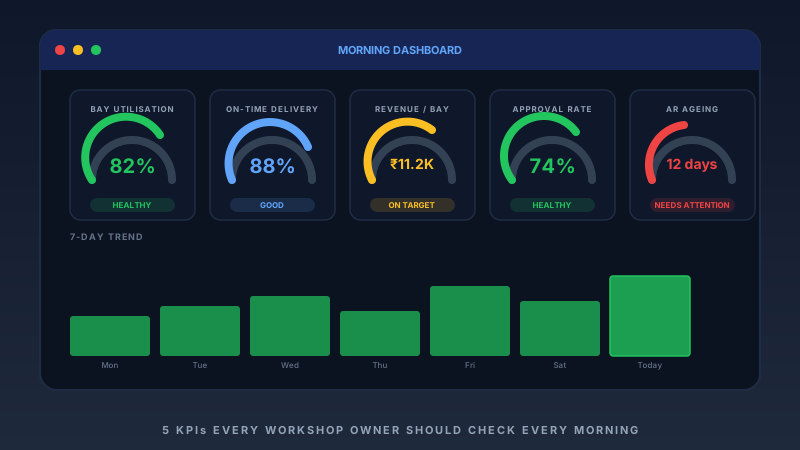
Most workshop management dashboards show 30-40 metrics. Nobody checks 40 numbers every day. The result: owners look at the dashboard once during onboarding, then never again.
Here are the 5 numbers that actually matter on a daily basis. If you check these every morning before the first car rolls in, you will catch problems 2-3 weeks before they become crises.
1. Bay utilisation rate (target: 75-90%)
``` Bay utilisation % = (Occupied bay-hours / Available bay-hours) x 100 ```
If you have 6 bays and run a 10-hour day, that's 60 available bay-hours. If 48 of those hours had a vehicle on the lift, utilisation is 80%.
Why daily: A single bad day is noise. Three consecutive days below 65% means your booking pipeline is drying up, or jobs are stacking at the estimate-approval stage.
Benchmark: 75-90% is healthy. Below 70% means you're paying for capacity you're not using. Above 95% means you have no buffer for walk-ins or overruns — customer experience will suffer.
2. Jobs completed vs jobs promised
Not total jobs — jobs promised for today that actually got delivered today.
``` On-time delivery % = (Jobs delivered on promised date / Jobs promised for today) x 100 ```
Why daily: This is the #1 driver of customer satisfaction. A workshop running at 60% on-time delivery is haemorrhaging trust. Customers don't complain about price — they complain about "you said 5 PM and it's still not ready."
Benchmark: 85%+ is good. 90%+ is excellent. Below 75% means systemic bottlenecks — usually parts delays, estimate re-approvals or technician allocation problems.
3. Revenue per bay per day (target: ₹8,000-₹15,000 for Indian independents)
``` Revenue per bay = Today's total invoiced revenue / Number of bays ```
Why daily: This is your core productivity metric. It combines utilisation, average ticket size, and throughput speed into one number. If utilisation is high but revenue per bay is low, you're doing low-value work. If utilisation is moderate but revenue per bay is high, you're doing high-value work efficiently.
Benchmark: ₹8,000-₹15,000 per bay per day for a well-run multi-brand independent in a metro or tier-1 city. Authorised dealers run higher (₹15,000-₹25,000) because of warranty billing rates.
4. Estimate approval rate (target: 70-80%)
``` Approval rate % = (Estimates approved / Estimates sent) x 100 ```
Why daily: If fewer than 65% of your estimates get approved, either your pricing is off, your communication is poor, or your advisors are padding estimates. Each unapproved estimate is a job you prepped for but didn't get paid for.
Benchmark: 70-80% is healthy. Above 85% might mean you're under-recommending (leaving money on the table). Below 60% needs immediate investigation.
5. Accounts receivable ageing (target: less than 7 days average)
How many rupees are owed to you, and how old are those dues?
Why daily: Workshops that don't track AR daily often discover ₹3-5 lakh in 60+ day overdue amounts at month-end. By then, collection is painful. Daily tracking lets you catch overdue accounts at 7 days, not 60.
Benchmark: Average AR age below 7 days for walk-in customers, below 30 days for fleet/insurance accounts.
How to actually check these every day
Don't open five reports. Your GMS should show all five on a single morning dashboard — ideally with colour coding (green / amber / red) and trend arrows (improving / declining).
If your current system can't show you these five numbers in under 10 seconds, it's not a dashboard — it's a reporting tool.
The compound effect
Individually, each KPI is useful. Together, they form a diagnostic picture:
- Low utilisation + low approval rate = booking and conversion problem
- High utilisation + low revenue per bay = wrong job mix (too many low-value jobs)
- High utilisation + high revenue + low on-time delivery = capacity or parts bottleneck
- Everything green + rising AR = you're doing the work but not collecting the money
GetAFix WMS shows all 5 KPIs on the owner's morning dashboard, updated in real time. No report-building required. See your numbers.
Related reading
How to choose the best garage management software in India (2026 guide)
A practical buyers' guide for Indian auto workshops and garage chains — from single-bay independents to multi-city franchises.
AI in automotive workshops: hype vs. reality in 2026
Everyone claims AI. This post cuts through the noise — what AI actually does inside a working garage today, and what is still marketing.